Color in Mandarin Chinese is 颜色 (yánsè). Red is 红色 (hóngsè), blue is 蓝色 (lánsè), and green is 绿色 (lǜsè). To ask an object's color, use 是什么颜色? (shì shénme yánsè?), "What color is it?", after the object.
Knowing the name gets you partway. If a shop assistant holds up a dark blue shirt when you wanted light blue, you need to change the shade, not start the conversation again.
Common colors, with pinyin
The final 色 (sè) means color. Learn these full forms first so you can put them straight into the sentences below. The readings and color meanings follow CC-CEDICT, credited at the end.
| Color | Chinese | Pinyin |
|---|---|---|
| White | 白色 | báisè |
| Black | 黑色 | hēisè |
| Gray | 灰色 | huīsè |
| Brown | 棕色 | zōngsè |
| Red | 红色 | hóngsè |
| Yellow | 黄色 | huángsè |
| Orange | 橙色 | chéngsè |
| Green | 绿色 | lǜsè |
| Blue | 蓝色 | lánsè |
| Purple | 紫色 | zǐsè |
| Pink | 粉色 | fěnsè |
You can also say 粉红色 (fěnhóngsè) for pink. Both names are useful; they do not need separate lessons.
Some color words work without 色 too: 蓝 (lán) means blue, and 紫 (zǐ) means purple. The cards below include these shorter forms. That does not mean you should remove 色 from every color expression you meet.
- hóng红sè色HSK2
red (color); revolutionary
- Example颜色yán sècolor; countenance
Ask the color, then describe the object
Use 衬衫 (chènshān), "shirt", as the object:
- 这件衬衫是什么颜色? (Zhè jiàn chènshān shì shénme yánsè?) What color is this shirt?
- 这件衬衫是蓝色的。 (Zhè jiàn chènshān shì lánsè de.) This shirt is blue.
件 (jiàn) is a counting word used with clothing. Here, 这件衬衫 means "this shirt". In the answer, keep 是 + color + 的 together as a pattern you can reuse.
When the color comes before the noun, use color + 的 + noun:
蓝色的衬衫 (lánsè de chènshān): a blue shirt.
These are two different jobs: the first sentence tells someone the shirt's color; the phrase identifies a blue shirt. Yoyo Chinese's Your Guide to Colors in Chinese, in "Helpful Examples", shows both describing an object's color and putting a color before clothing.
If the object is already clear, 的 (de) can stand at the end without repeating its name:
我要蓝色的。 (Wǒ yào lánsè de.) I want the blue one.
This use of 的 appears in CC-CEDICT's entry for the particle. Without a shared object in the conversation, "the blue one" leaves your listener guessing what you want.
Change light blue to dark blue
Put 浅 (qiǎn), light, or 深 (shēn), dark, before the color:
- 浅蓝色 (qiǎn lánsè): light blue.
- 深蓝色 (shēn lánsè): dark blue.
- 浅绿色 (qiǎn lǜsè): light green.
- 深绿色 (shēn lǜsè): dark green.
Yoyo Chinese's "Degrees of colors" section teaches this shade pattern. These are descriptions, not exact paint codes: if the precise shade matters, show the object or a sample too.
Try this exchange with two shirts in front of you:
- You: 有浅蓝色的吗? (Yǒu qiǎn lánsè de ma?) Do you have a light blue one?
- Assistant: 深蓝色的? (Shēn lánsè de?) The dark blue one?
- You: 浅蓝色的。 (Qiǎn lánsè de.) The light blue one.
Repeating just 蓝色 would not fix the misunderstanding. The word that needs to change is 浅 or 深.
A color inside a word may not translate literally
红茶 (hóngchá) is black tea in English, even though 红 (hóng) means red. CC-CEDICT gives the whole word's meaning as black tea. Learn that name as a unit rather than changing it to match the English color.
Our food-ordering guide puts drink choices into a restaurant exchange. For another travel use, try describing the color of your bag when asking about it at the front desk after checking into a hotel.
Choose a shade without looking
Cover the examples above and answer aloud.
- Say "a gray shirt".
- Two shirts are on the counter. Ask for the green one without repeating "shirt".
- You want light blue, but someone repeats "dark blue?" Correct only the shade phrase.
- A menu lists 红茶 (hóngchá). What drink is it?
Suggested answers:
- 灰色的衬衫。 (Huīsè de chènshān.) A gray shirt.
- 我要绿色的。 (Wǒ yào lǜsè de.) I want the green one.
- 浅蓝色的。 (Qiǎn lánsè de.) The light blue one.
- Black tea.
Now check the color words without the sentence clues.
白色Tap to reveal
báisèwhite
黑色Tap to reveal
hēisèblack
灰色Tap to reveal
huīsègray; ash gray
棕色Tap to reveal
zōng sèbrown
红色Tap to reveal
hóngsèred (color); revolutionary
绿色Tap to reveal
lǜsègreen
Got it: 0 of 6
When a color word appears on Lock In's Lock Screen widget, look for an object nearby and say its color aloud. Then try the light or dark version. This is your own speaking exercise; the widget does not identify objects, check colors through the camera or grade your sentence.
Further reading
- Ashley LaBrie, Yoyo Chinese, Your Guide to Colors in Chinese: "Colors Vocabulary", "Degrees of colors" and "Helpful Examples", for color names, shade modifiers and sentence patterns.
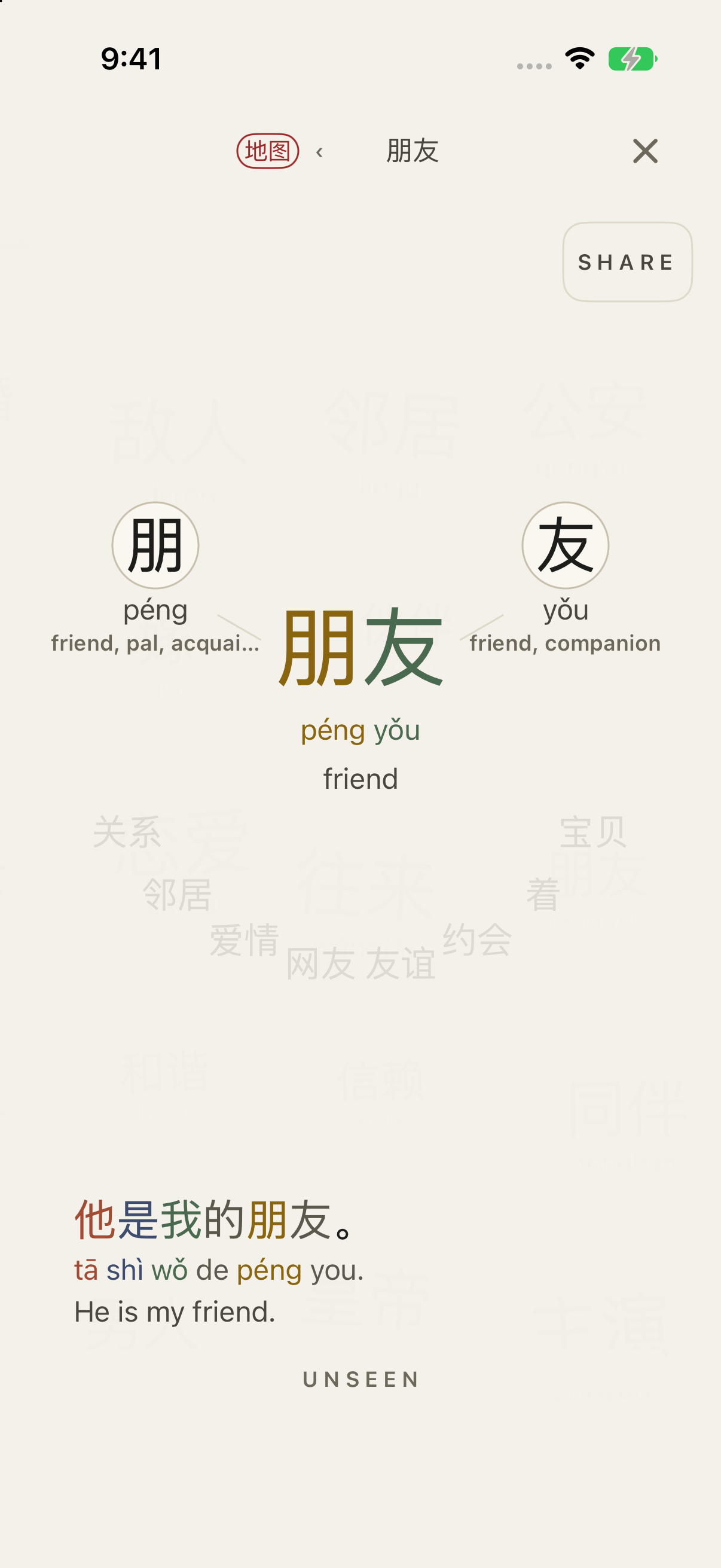
Every word opens like this in Lock In
Characters, readings and a real sentence, on your lock screen.

Word data: CC-CEDICT, CC BY-SA 4.0, adapted.