Most language apps have the same quiet problem. They wait for you to open them. The flashcards sit behind an icon, and the icon sits on a home screen you swipe past all day without stopping. Motivation is the fuel, and motivation runs out.
The thing in your hand has a neat name in Chinese. A mobile phone is 手机 (shǒujī), a "hand machine". This post is about the few seconds after you pick up the hand machine, and what a Chinese word can do with them.
The flashcards you never open
A flashcard is only useful in the two seconds you look at it. The trouble is getting to those two seconds. You have to remember the app exists, decide now is the time, and beat the pull of everything else on the phone. On a tired evening, the app loses that fight almost every time.
Here is the vocabulary of that fight.
- dǎ打kāi开HSK2
to open; to show (a ticket)
- Example打电话dǎ diàn huàto make a telephone call
- duǎn短xìn信HSK4
text message; SMS
- Example相信xiāng xìnto believe; to be convinced
- mǎ马shàng上HSK3
at once; right away
- Example上午shàng wǔmorning (before noon)
马上 means "right away", and the characters say "on horseback": already mounted and leaving. Nobody opens a flashcard app 马上. It is the app you will open in a minute.
Meet one word every time you reach for your phone
Lock In puts a single character where you already look. You reach for your phone, and before the scroll begins, one word is waiting. You are not studying. You are glancing, the way you glance at the time. Every glance is a tiny encounter you never had to schedule.
Two verbs help here. 看 (kàn) is to look. 看见 (kànjiàn) is to look and have it land: to catch sight of something.
The same pair exists for sound. 听 is to listen, and 听见 is to actually hear. A lock screen turns your glances into 看见. The word is there long enough to register, and it is there again next time.
A glance gives you exposure. Seeing a word many times makes it familiar. Pulling it out of memory on your own is a separate skill, which is why the routine needs a recall step too.
Repetition without willpower
In 1885 Hermann Ebbinghaus tested himself on lists of nonsense syllables and charted how fast he forgot them. The shape he found is now called the forgetting curve: memory drops quickly at first, then more slowly. Reviews spread out over time slow the drop, an effect known as spacing.
Spaced repetition works, and the hard part was always the scheduling. Lock In schedules the recall step for you. The glances keep the word familiar in the hours between. The character you saw this morning is the one you quiz yourself on before the seal on your social apps lifts tonight.
The memory words hide a small joke. 记 (jì) means to record or note down. 忘 (wàng) means to forget. The everyday word for forgetting puts them together: forget + record.
Read literally, to forget is to "forget the record". Keep the record and you get 记得 (jìde), to remember. A third word sits between them: 认识 (rènshi), to know or recognise. Teachers ask 你认识这个字吗? "Do you recognise this character?" 认识 is what a glance gives you. 记得 is what the quiz asks for.
看见Tap to reveal
kàn jiànto see; to catch sight of
听见Tap to reveal
tīngjiànto hear
认识Tap to reveal
rèn shito know; to recognize
记得Tap to reveal
jì deto remember
忘记Tap to reveal
wàng jìto forget
马上Tap to reveal
mǎshàngat once; right away
小时Tap to reveal
xiǎo shíhour
短信Tap to reveal
duǎn xìntext message; SMS
Got it: 0 of 8
Small on purpose
We do not want an hour of your day. The Chinese hour already has a small name. The traditional day had twelve 时 (shí), each about two modern hours long (traditional Chinese timekeeping). The modern hour is half of one, so it became 小时 (xiǎoshí), a "small 时". We want something smaller still.
What we want is the ten seconds you would have spent unlocking anyway. Learn the character, earn the scroll, put the phone down. That is the whole loop, and it is small on purpose.
Put a few words into the routine
HSK 1 in your pocket gives you a beginner starting point. Choose your first group from our HSK 1 words list, then return to those words before adding more. If you are deciding which tool to use, our Chinese flashcards app guide explains what to check before paying.
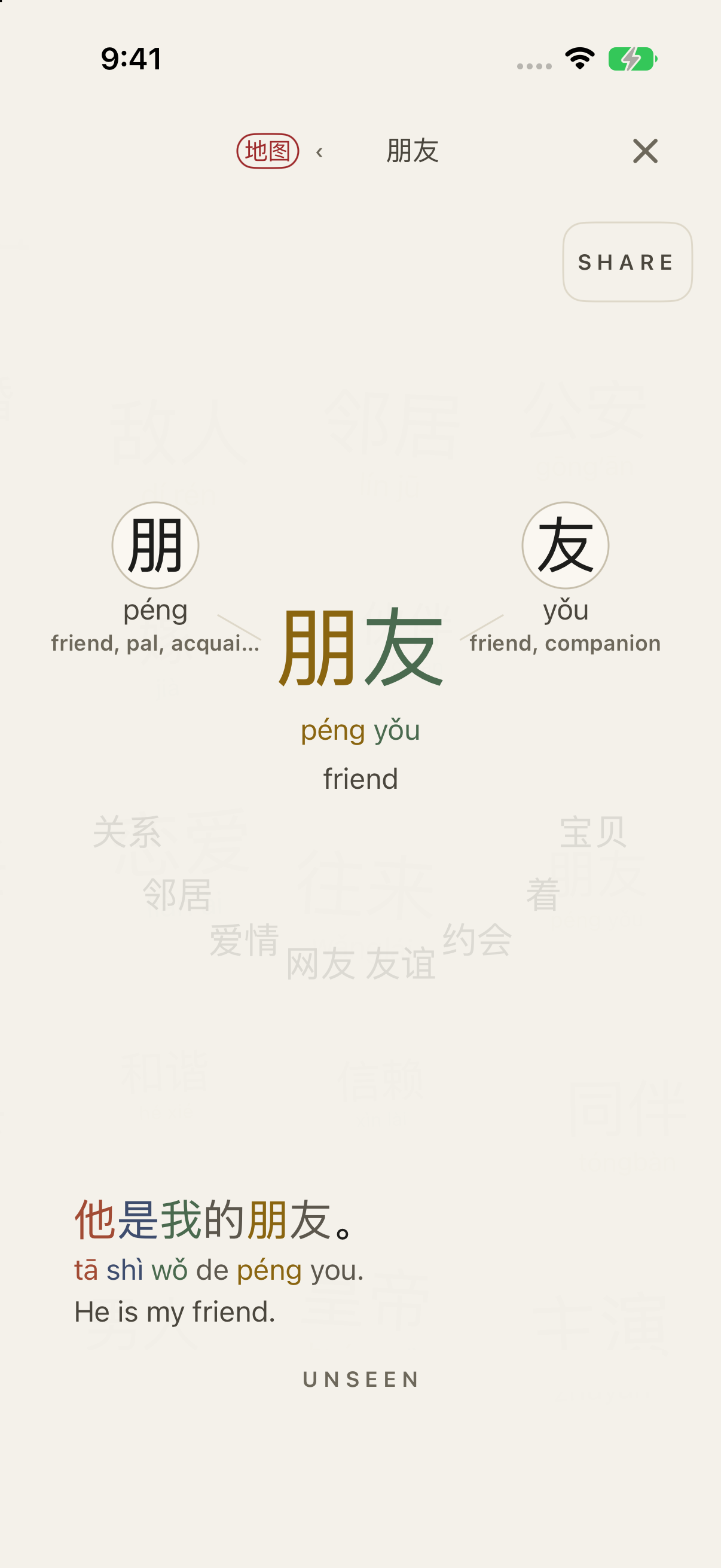
Every word opens like this in Lock In
Characters, readings and a real sentence, on your lock screen.

Word data: CC-CEDICT, CC BY-SA 4.0, adapted.