How many Chinese characters do you really need?
HSK has 5,400 words. Learn the right 300 characters first and you can read half again as many of them.
Learn three hundred Chinese characters in textbook order and you can read about one HSK word in five. Learn the three hundred that appear in the most words and that rises to almost one in three, for the same effort.
HSK1 to HSK6 holds 5,400 words, built from 1,940 distinct characters. The lab below races two learning orders on one measure: how many words contain only characters you already know.
- HSK 140.7%
- HSK 250.0%
- HSK 339.2%
- HSK 433.0%
- HSK 529.3%
- HSK 622.5%
Same effort, more Chinese
At three hundred characters, the most reused set makes 1,622 words readable, or 30.0% of all HSK words. Textbook order makes 1,036 readable, or 19.2%. That is a gap of about eleven percentage points.
The two orders are close relatives. Most reused first ranks each character by how many words contain it. Textbook order finishes the HSK1 characters before it starts on HSK2, and so on up the levels, and uses reuse to rank characters inside each level. So textbook order already gets some benefit from reuse. The comparison measures what level boundaries cost.
Reuse order spreads its gains across every level. At three hundred characters it already covers 50.0% of HSK2 and 22.5% of HSK6. Textbook order covers 9.8% of HSK6 at the same stop, because it has not reached most of the characters those words need. Most of the headline gap comes from the top levels. HSK1 has 300 words and HSK6 has 1,800, so HSK5 and HSK6 together hold most of the words: 29.6% and 33.3% of all words.
The gap opens almost at once. With one hundred characters, reuse order already covers 9.5% of all HSK words and textbook order 7.3%, and the distance widens, with small dips, until six hundred and sixty characters. At five hundred characters, reuse order reaches 48.4% and textbook order 36.8%, about twelve points apart. Reuse order passes half of all HSK words at five hundred and twenty characters, with 50.1%. Textbook order needs seven hundred and twenty to get there, two hundred more characters for the same result.
The gap peaks at six hundred and sixty characters, about seventeen points: 60.4% against 43.1%. After that the curves close in. At one thousand characters, reuse order covers 4,206 words, or 77.9%. Textbook order covers 3,727, or 69.0%, about nine points behind. The two lines meet at one thousand six hundred and sixty characters and stay together to the full 1,940 characters.
At three hundred characters, the order you choose is worth about eleven points of reading coverage.
The characters doing the most work
子 sits in more HSK words than any other character, 74 of them, from 包子 to 鼻子. 人 follows with 64, then 不 with 59. The top twenty-four, with example words for each, are in the grid below. Even the twenty-fourth, 力, appears in 32 words. Nine characters each sit in more than forty words. 出 starts 出版, 出差 and 出发, and 生 ends 产生, 诞生 and 发生.
子 closes everyday nouns such as 杯子 and 被子. 不 negates, and 一 and 大 turn up inside compound after compound. Each one comes back in words you have not studied yet.
- 子
- zi noun suffix
- bāo包zi子baozi; bao (steamed stuffed bun)
- bēi杯zi子cup; glass
- ér儿zi子son
- hái孩zi子child
- 人
- rén person; people
- jiā家rén人family member
- bié别rén人other people; others
- kè客rén人visitor; guest
- nán男rén人a man; a male
- 不
- bù no; not so
- bú不kè客qi气you're welcome; don't mention it
- bú不yào要don't!; must not
- duì对bu不qǐ起I'm sorry; excuse me
- bù不hǎo好yì意si思embarrassed; sorry
- 大
- dà big; large
- dà大jiā家everyone
- dà大xué学university
- dà大xué学shēng生university student
- dà大gài概roughly; probably
- 一
- yī one; single
- yì一diǎn点er儿a little; a bit
- yí一bàn半half
- yí一xià下a bit; a little
- yì一xiē些some, a few
- 出
- chū to go out; to come out
- chū出zū租chē车taxi
- chū出guó国to go abroad
- chū出lái来to come out; to appear
- chū出mén门to go out; to leave home
- 生
- shēng to be born; to give birth
- shēng生bìng病to fall ill
- xiān先sheng生teacher; gentleman
- xué学shēng生student; schoolchild
- yī医shēng生doctor
- 动
- dòng to move; to set in motion
- yùn运dòng动to exercise; sport
- dòng动wù物animal
- dòng动wù物yuán园zoo
- yùn运dòng动huì会sports meet
- 学
- xué to learn; to study
- xué学shēng生student; schoolchild
- xué学xí习to learn; to study
- xué学xiào校school
- shàng上xué学to go to school
- 面
- miàn face; side
- miàn面bāo包bread
- miàn面tiáo条noodles
- hòu后miàn面the back; the rear
- qián前miàn面ahead; in front
- 发
- fā to send out; to express
- chū出fā发to set off; to depart
- fā发shēng生to happen; to occur
- fā发xiàn现to notice; to become aware of
- fā发zhǎn展development; growth
- 心
- xīn heart; mind
- dān担xīn心anxious; worried
- guān关xīn心to care about
- kāi开xīn心to feel happy; to rejoice
- fàng放xīn心to feel relieved
- 地
- de -ly; adverbial particle
- dì earth; ground
- dì地tiě铁underground railway; subway
- dì地fang方place; location
- dì地tú图map
- cǎo草dì地lawn; meadow
- 上
- shàng up; above
- shàng上wǔ午morning (before noon)
- wǎn晚shang上evening; night
- zǎo早shang上morning
- shàng上bān班to go to work; to be on duty
- 中
- zhōng middle; in; among
- zhòng to hit; be struck
- zhōng中guó国China
- zhōng中wén文Chinese language
- zhōng中wǔ午noon; midday
- zhōng中xué学middle school
- 用
- yòng to use; to make use of
- xìn信yòng用kǎ卡credit card
- bú不yòng用need not
- cháng常yòng用in common usage
- yǒu有yòng用useful
- 行
- xíng to walk; to go (formal)
- háng line; trade
- yín银háng行bank
- zì自xíng行chē车bicycle; bike
- bù不xíng行won't do; be out of the question
- xíng行li李luggage
- 好
- hǎo good; appropriate
- hào to be fond of
- hǎo好chī吃tasty; delicious
- nǐ你hǎo好hello; hi
- hǎo好kàn看good-looking; nice-looking
- hǎo好tīng听pleasant to hear
- 外
- wài outside; in addition
- wài外bian边outside; outer surface
- wài外guó国foreign country
- wài外miàn面outside
- wài外dì地other parts of the country
- 年
- nián year
- qù去nián年last year
- míng明nián年next year
- jīn今nián年this year
- guò过nián年to celebrate Lunar New Year
- 有
- yǒu to have; there is
- méi没yǒu有not have; not exist
- yǒu有de的some
- yǒudiǎnr有点儿slightly; a little
- yǒu有xiē些some; somewhat
- 时
- shí o'clock; time
- shí时hou候time; length of time
- shí时jiān间time
- xiǎo小shí时hour
- xiǎo小shí时hou候in one's childhood
- 期
- qī period; cycle
- xīng星qī期week
- xīng星qī期rì日Sunday
- xīng星qī期tiān天Sunday
- xué学qī期term; semester
- 力
- lì power; force
- nǔ努lì力to make an effort; to try hard
- lì力qi气physical strength
- néng能lì力capability; ability
- qiǎo巧kè克lì力chocolate
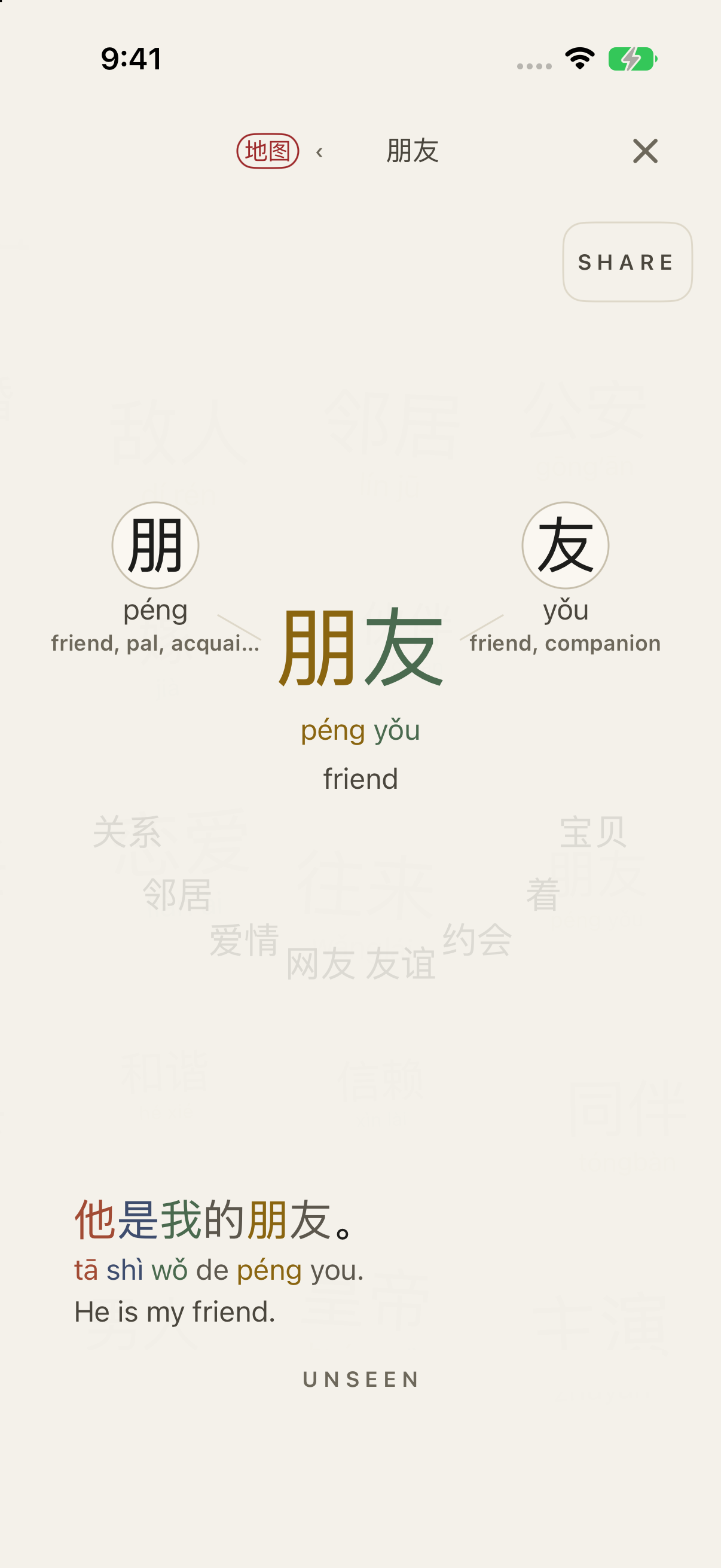
Every word opens like this in Lock In
Characters, readings and a real sentence, on your lock screen.

One character rarely makes a word readable on its own. 不安 needs 安 as well as 不, and the chart only counts a word once you know every character in it. The curve moves only when a set of characters completes whole words, and the most reused characters complete more of them sooner.
What this means for how you study
If you want to read, learn the most reused characters early. If you have an exam date, learn your level first.
Textbook order makes every HSK1 word readable by two hundred and sixty characters. HSK1 words use 248 distinct characters, and textbook order learns them first. At three hundred characters, textbook order covers 100.0% of HSK1, while reuse order covers 40.7%. Even at one thousand characters, reuse order still leaves HSK1 at 85.7%. Reuse order wins across all of HSK and loses on the level you are about to sit.
The same trade runs up the levels. Textbook order has finished HSK2 as well by five hundred characters, with 100.0%, while reuse order covers 66.5%. At one thousand characters, textbook order has finished HSK3 and covers 90.9% of HSK4, where reuse order covers 83.0% and 82.7%. Textbook order pays for this at the top levels. At one thousand characters, HSK6 sits at 48.7% in textbook order and 68.8% in reuse order.
Learn the characters for your target level first. Then switch to the most reused characters you still lack, using the grid to pick the next small group. Keep the group small enough that you can recall every form later with the answers hidden.
Learn each character inside the words it completes, with the reading and meaning of each word. Add 安 to 不 and 不安 becomes readable. Add 发 to 出 and 生 and both 出发 and 发生 become readable. Then test yourself on the whole word: read it, say it and use it in a sentence.
Hacking Chinese makes a similar case from a learner's side: choose characters partly by how often they are used, and study them through the components they are built from.
Two limits apply to every number in this piece. Every word counts once, however common or rare it is in real text. And "readable" means you recognise every character in a word. It does not mean you know the word, its pronunciation or how to use it.
Word play
Some Chinese words are tiny stories. Put two characters side by side and the meaning almost explains itself. Not every compound works like this, but the ones that do are the easiest words you will ever remember.
A fire vehicle is a train. Chinese named it in the age of steam engines, and the name stuck long after the fire went out.
A big person is an adult. It is the word children use for the grown-ups around them.
Keep your heart small and you are being careful. You will see 小心 on wet floors, steep steps and the edges of train platforms all over China.
Open your heart and you feel happy. Put 开心 next to 小心 and you have a pair: the same 心, two very different moods.
Tips and tricks
- Pick your goal first. Sitting HSK1 soon? Textbook order already covers 100.0% of HSK1 at three hundred characters. Want to read widely? Follow the most reused characters.
- Tap or hover a card, then hide the answers. Read each example word aloud and check the reading. Knowing the shape is step one, saying the word is step two.
- Learn characters in pairs. 不 alone does not get you 不安. Add 安 and a new word unlocks, and so does every other word built from the two.
- Hunt for word play. When a word looks like a little story, like 火车 or 小心, write the story down. Silly pictures stick.
Every word opens like this in Lock In
Characters, readings and a real sentence, on your lock screen.
Word data: CC-CEDICT, CC BY-SA 4.0, adapted.