The Chinese word for a card is 卡片 (kǎpiàn). The 卡 is usually explained as a sound borrowed from English "card", and 片 means a thin, flat piece. A flashcard is a thin piece of card, in two languages at once.
A Chinese flashcards app has to do more than hold a large pile of them. It has to help you meet a word, recall it later, and return when your day is busy. Before you pay, try a small group of words and look closely at the routine around them. Each section below ends with a test you can run in a few minutes.
Start with the words you need
Choose words that match the Chinese you are studying. Check the curriculum version as well as the level name. A label that says HSK 1 does not tell you which vocabulary list sits underneath it. Open a few words and check the characters, readings and meanings together.
Lock In Chinese follows HSK 3.0, where HSK 1 has 300 words. Browse some of them in our HSK 1 words list and see whether they fit your starting point. You want words you can practise now, rather than a large number to admire.
The words for what flashcards do borrow from the kitchen. A new word is a 生词 (shēngcí), a "raw word". 生 has several jobs: it can mean born, student or unfamiliar, and here it means raw, as in uncooked. A word you know well has been cooked until 熟 (shú), "ripe" or "done". The same pair describes people.
A "ripe person" is an acquaintance, someone familiar. A flashcards app's job is to take raw words and make them ripe, a few at a time.
Look for recall, then spaced repetition
A card you recognise is not always a word you can retrieve. Try recalling the meaning before revealing it. Later, try remembering the Chinese from an English prompt. Notice which direction feels harder. Both can deserve attention.
Ask how the app returns older words. Does a missed answer change the next review? Can an easy word wait longer? A useful schedule responds to recall, rather than treating every word as equally urgent forever.
Lock In uses a memory model to schedule vocabulary reviews. Its Personalized Path serves due reviews before introducing new words near your placement boundary. The schedule changes with your answers. A lock-screen glance gives exposure; it does not count as successful recall. That distinction matters when you are deciding what progress means.
The Chinese words for this part of studying are worth having on your own cards.
复习 (fùxí), to review, is "again practise". 练习 (liànxí) is "train and practise". Both contain 习, to practise. A review schedule decides when each word gets its next round of 复习.
Keep characters and pinyin connected
Pinyin is useful when the characters are new. It can also become the only part you read. Check that your practice gives the characters room to stand alone, so you can discover what you know without the reading underneath.
The word itself explains why. 拼音 (pīnyīn) is "pieced-together sound", a spelling of the sound and nothing more. Sound is crowded in Chinese. Of the 300 HSK 1 words, 16 share their exact pinyin, tone marks included, with another HSK 1 word. 他, 她 and 它 are all tā. 钱 (money) and 前 (front) are both qián. 再 (again) and 在 (at) are both zài.
Lock In supports both character-and-pinyin prompts and character-only meaning prompts. Its words come with pinyin and English meanings. This lets you begin with reading support and practise recognition without it. Start gently, but do not judge character knowledge from an answer that pinyin gave away.
Try the same word in each direction. If you can read its pinyin but cannot recognise its written form, that is useful information. You have found the part to practise next.
Check what audio actually covers
Strip the tone marks from those 300 words and the collisions jump from 16 words to 50. 十 (shí, ten), 是 (shì, to be) and 事 (shì, matter) all collapse into "shi". The tones do a lot of the work of keeping words apart, and you only learn tones by hearing them.
The classic drill is ma: mā (mother), má (hemp), mǎ (horse), mà (scold). That is four meanings on one syllable, separated only by pitch. A written reading cannot carry that to your ear.
Listening ability in Chinese is "hearing power". Build it by playing words aloud. Play a familiar word and an unfamiliar one. Listen, pause, and try saying each yourself. Check whether the app tells you when a recording is ready and when it still has to be fetched.
Lock In has audio playback and an Audio packs section in Settings. Saved packs play offline once they are ready. Do not assume a visible play control means every recording is already on the phone. Prepare the words you need before a trip, then check playback with the connection turned off.
You are choosing a vocabulary tool, so keep the audio test concrete. Can you hear the words you are learning this week? Can you repeat a word without looking at its reading? Those questions help more than a promise about a complete language course.
Measure the effort of returning
Think about an ordinary tired evening. Will you remember to open another study app? How many choices stand between you and the first word? A beautiful app can still ask for more attention than you have left.
Lock In offers Lock Screen widgets and quizzes before access to apps you choose to seal through Screen Time. Correct recall opens access for a set window. That makes vocabulary part of a phone habit you already have. It also means you must be comfortable placing that small interruption before selected apps. Choose the routine because you want it, not because a feature list sounds impressive.
Our lock-screen learning guide explains the rhythm. HSK 1 in your pocket gives a beginner starting point. Read both and picture where a glance and a recall question would fit in your day.
Separate offline study from what needs a signal
The internet has a direction in Chinese. Going online is 上网 (shàngwǎng), "going up onto the net". Saving a file from the internet is 下载 (xiàzài), "loading down". Offline study depends on what came down before you lost the signal.
Offline is a question to test, not a box to trust. Before paying for any app, turn off the connection and try the exact things you need: opening a word, reviewing it and playing its sound. Fetching audio and checking purchases are separate from an ordinary review.
Lock In keeps its vocabulary on your phone, and saved audio packs play offline. Not every feature works without a connection, so run your own test before you rely on it while travelling.
Read the purchase terms before agreeing
At the till, two characters are easy to mix up. To buy is 买 (mǎi). To sell is 卖 (mài). The two differ by one tone and by the small 十 on top of 卖. Mix them up and you have offered to sell the thing you came to buy.
免费 (miǎnfèi), "exempt from the fee", means free of charge. When you see it, check what it covers and for how long.
Compare the billing period, renewal amount and any introductory offer. A small weekly amount and an annual charge are different commitments. Read the full charge shown for the selected plan, not only a smaller equivalent amount.
Lock In offers subscription access. Its purchase screen shows the selected product's billing terms. Settings includes Restore purchases and subscription management for an active store subscription. Check the offer presented to your account before buying. Do not assume a trial is available to everyone.
Choose with a small real trial of the routine
Use a few words from the list, then return to them the next day. Run the checks in this table on any app you are considering, Lock In included.
| What to check | How to test it | A good sign |
|---|---|---|
| The word list | Open five words at your level | Characters, pinyin and meanings match your course |
| Recall | Answer before revealing, in both directions | A missed word comes back sooner than an easy one |
| Characters | Hide the pinyin | You can still practise from the character alone |
| Audio | Play 买 and 卖, then 十 and 是 | You hear the tone difference, and the app says when audio still has to be fetched |
| Returning | Picture a tired evening | The first word is one step away |
| Offline | Turn off the connection | Reviews and saved audio still work |
| Price | Read the full charge and renewal | You know what you pay and when |
Before you decide, test yourself on the words from this page.
卡片Tap to reveal
kǎpiàncard
熟人Tap to reveal
shúrénacquaintance; friend
复习Tap to reveal
fù xíto review; revision
下载Tap to reveal
xiàzàito download; also pr. [xia4zai4]
免费Tap to reveal
miǎn fèifree (of charge)
买Tap to reveal
mǎito buy; to purchase
卖Tap to reveal
màito sell; to betray
听力Tap to reveal
tīnglìhearing; listening ability
Got it: 0 of 8
Notice whether you remember the characters, hear the sounds and tolerate the interruptions you selected. If Lock In's small recall step fits your phone use, it is a reason to consider it. If you need a different routine, keep that need clear before you pay. The useful app is the one you can return to with care.
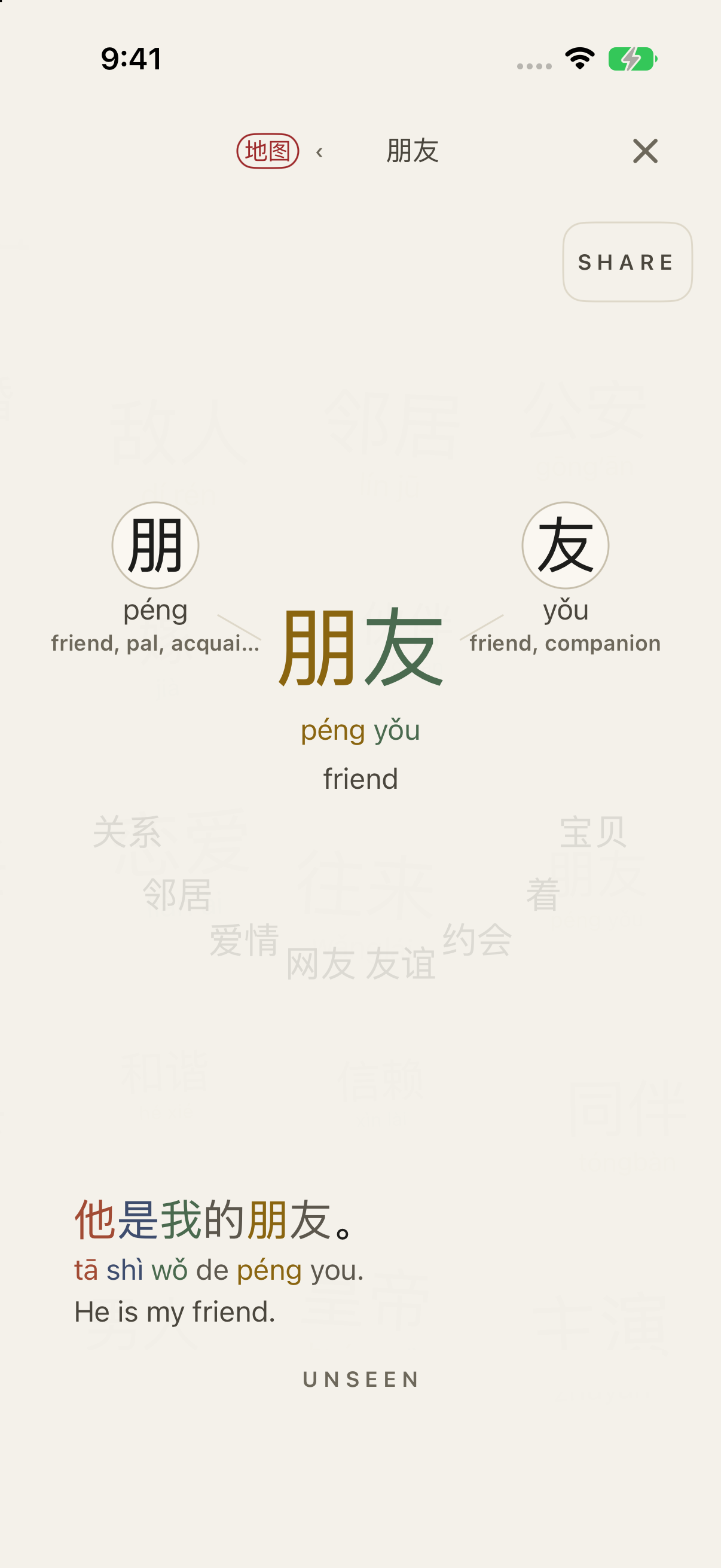
Every word opens like this in Lock In
Characters, readings and a real sentence, on your lock screen.

Word data: CC-CEDICT, CC BY-SA 4.0, adapted.