HSK 1 is the first rung of the Chinese proficiency ladder. In HSK 3.0 it has 300 words. That is enough to greet someone, count, order tea and say where you are going.
Three hundred sounds like a lot to carry in a pocket. It is smaller than it looks, because HSK 1 words are made of each other.
What a small word group gives you
Start with five words you can reach for every day.
Those five already make sentences. 我是学生 (wǒ shì xuéshēng) is "I am a student". 我有茶 is "I have tea". And two of them stuck together give you the first word every learner says.
"You good" is hello. Chinese builds a lot of HSK 1 this way. Of the 300 HSK 1 words, 51 longer words are made entirely from single-character HSK 1 words, so each small word you learn pays out again later. Our HSK 1 words list has more numbers like that.
One character at a glance
Instead of a lesson, HSK 1 arrives as a slow drip. Each day a new character sits on your lock screen with its pinyin and meaning. 学, xué, to learn. You see it at breakfast, in the elevator, while you wait for coffee. By evening it is familiar.
学 is a good character to meet that way, because it keeps coming back. It appears in twelve HSK1 words, more than any other character in the level.
- xiǎo小xué学shēng生HSK1
primary school student
- Example生病shēng bìngto fall ill
Read the grid as a ladder. 小学 is "small learning", primary school. 中学 is "middle learning", secondary school. 大学 is "big learning", university. Add 生, which in these words means a student, and each one turns into the person who studies there: 小学生, 中学生, 大学生.
"Same learning" is a classmate: the person who learns the same things you do, in the same room.
From glance to recall
Recognition comes first, then recall. A glance tells you the shape is familiar. Recall asks you to produce the word with nothing to lean on. After a character has ridden your lock screen for a few days, the quiz flips it: you see the meaning and reach for the character. That flip is where a word moves from something you have seen to something you know.
Try the flip now on the words above.
你好Tap to reveal
nǐ hǎohello; hi
学生Tap to reveal
xué shēngstudent; schoolchild
学校Tap to reveal
xué xiàoschool
同学Tap to reveal
tóngxuéclassmate
大学Tap to reveal
dàxuéuniversity
小学Tap to reveal
xiǎoxuéelementary school
Got it: 0 of 6
If 小学 and 大学 trip you up, that is the ladder doing its job. The two words differ by one character, so you have to read the character instead of guessing from the shape of the whole word.
A pocket-sized finish line
Begin with five words and return to them before adding more. There is no study block and no streak to protect. The words go where you were going to look anyway.
The phrase you will use most on a busy day is a bit; a little, "a little bit" or "a moment". 等一下 (děng yíxià) means "wait a moment". It is also a fair description of the routine: one moment, then back to your day.
Choose your next words
Use our HSK 1 words list to choose a small group with readings and English meanings. For the daily rhythm, read how lock-screen learning works. Before choosing a paid tool, use our Chinese flashcards app guide to check review, audio and purchase terms.
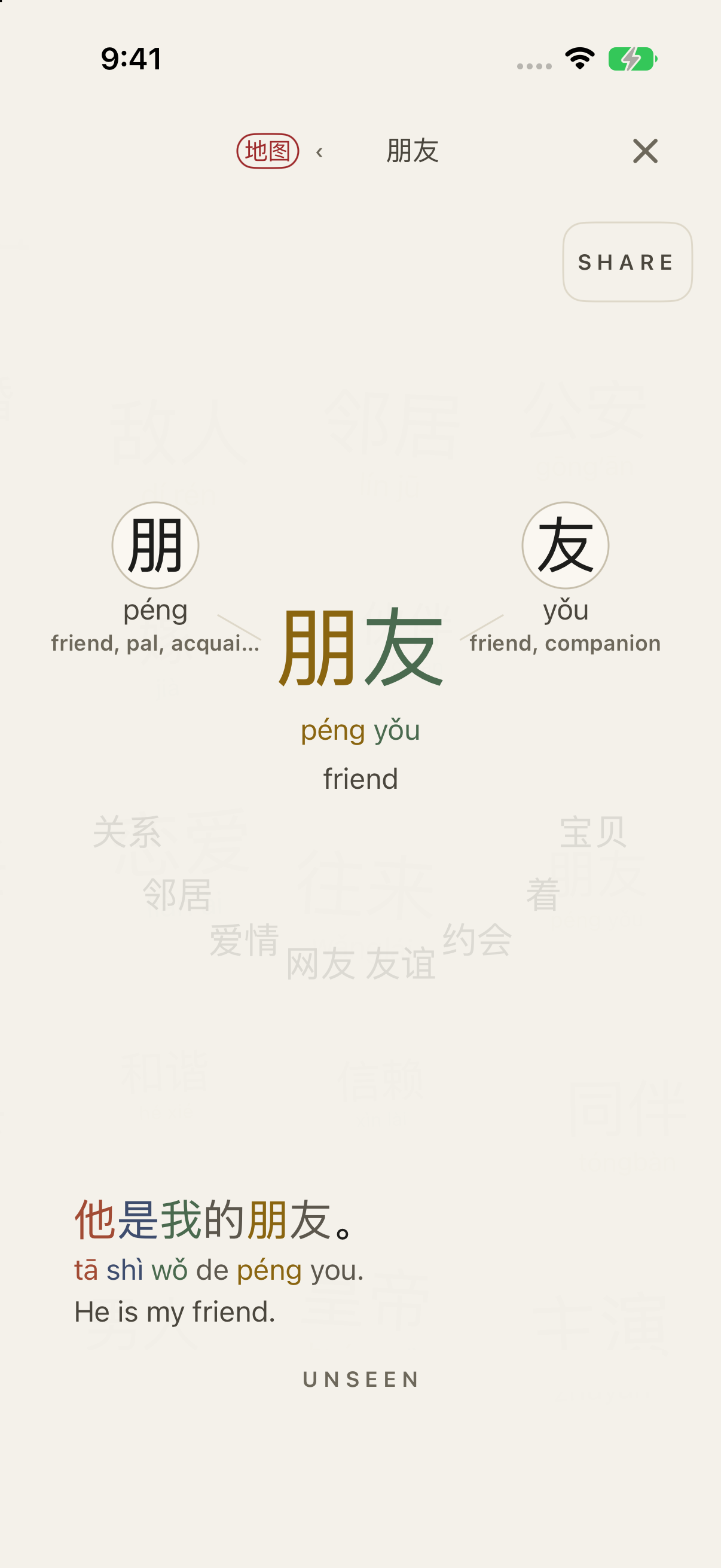
Every word opens like this in Lock In
Characters, readings and a real sentence, on your lock screen.

Word data: CC-CEDICT, CC BY-SA 4.0, adapted.