In Chinese, breakfast is 早饭 (zǎofàn), "early rice". Lunch is 午饭, "noon rice". Dinner is 晚饭, "evening rice". Learn 饭 and the three meals of the day explain themselves.
That is the fun part of HSK 1. The words are short, they share parts, and many of them explain themselves once you look inside. Below are 47 of them, grouped by theme, with a few stories to make them stick. Tap any card to see its level and an example word.
HSK 1 is 300 words
HSK 1 is the first level of HSK 3.0, and it has 300 words. The older HSK 2.0 version had 150. Of the 300, 137 are a single character, 145 are two characters and only 18 are three. All 300 use 248 distinct characters, so characters repeat a lot.
If you arrived through HSK 1 in your pocket, this is the word list to keep beside it. Start with one theme. There is no prize for finishing the page in one sitting.
Numbers you can say aloud
Chinese numbers are arithmetic you can hear. Eleven is 十一 (shí yī), "ten one". Twenty is 二十 (èr shí), "two ten". Ninety-nine is 九十九, "nine ten nine". Once you know these ten cards, you can count to 99 without a single new character.
Two numbers carry extra weight. 四 (sì) sounds close to 死 (sǐ), "to die", and some buildings in China have no fourth floor because of it (tetraphobia has the details). 八 (bā) sounds close to 发 (fā), as in getting rich. The Beijing Olympics opened at 8:08 pm on 8 August 2008 for exactly that reason, according to Wikipedia's page on Chinese numerology.
One trap for beginners: when you count, two is 二. When you have two of something, you use two; both instead. Two cups of tea takes 两, not 二.
The pinyin here is the dictionary reading. In a sentence, some tones shift (一 changes tone depending on the word after it). Learn the dictionary form first, then listen to the word in context. A tone mark belongs to the word.
People around you
Say 他 and 她 aloud. They sound identical: both are tā. So is 它, the word for "it". Spoken Chinese does not tell you whether someone means he, she or it. Only the writing does.
The written difference is young. 他 has the person radical 亻 on the left, and 她 swaps it for 女, "woman". The writer Liu Bannong is credited with coining 她 in the late 1910s, and a 1930s pop song with his lyrics helped spread it (Liu Bannong on Wikipedia).
Two more small stories hide in this group. 们 (men) turns a person into a group: 我 is I, 我们 is we, and the same 们 makes 你们 and 他们. And the 老 (lǎo, old) in 老师 shows respect. A 25-year-old teacher is still 老师.
先生 is "first born". It means a gentleman or a teacher, and it is how you address a man as "Mr.": 王先生 is Mr. Wang.
Pick three words from this group and attach each to someone real: your teacher, a friend, yourself. Look at the characters while you say the reading, then look away and recall the meaning. You want shape, sound and meaning to travel together.
四Tap to reveal
sìfour; 4
八Tap to reveal
bāeight
十Tap to reveal
shíten; 10
她Tap to reveal
tāshe
我们Tap to reveal
wǒ menwe; us
朋友Tap to reveal
péng yǒufriend
老师Tap to reveal
lǎo shīteacher
学生Tap to reveal
xué shēngstudent; schoolchild
Got it: 0 of 8
Time, one day at a time
The Chinese calendar on this list is made of the sun and the moon. 日 (rì) means sun and day. 月 (yuè) means moon and month. Put them side by side and you get 明 (míng), "bright", the first half of 明天, tomorrow. Tomorrow is the bright day.
Morning and afternoon sit on a vertical line. 上午 is "above noon" and 下午 is "below noon", as if the day runs from top to bottom like a hanging scroll. The same 上 and 下 give you 上个月 (last month) and 下个月 (next month). Up is earlier, down is later.
天 also means sky, and the sky's air is the weather. When someone in Beijing complains about 天气, they are complaining about the sky.
Choose the word for today when you begin. Later, come back to the words for morning and afternoon at the hour they describe. A word attached to the hour you are living has something to hold on to.
Verbs for a small ordinary day
- dú读HSK1
to read out; to read aloud
- Example读书dúshūto read a book; to study
Look at the left side of 吃 (eat), 喝 (drink) and 听 (listen). Each carries 口 (kǒu), "mouth". 说 (speak) and 读 (read aloud) carry 讠 instead, the speech radical. In this group you can often guess which verbs involve your mouth before you know a single reading.
学 (xué), to learn, turns up in more HSK 1 words than any other character. HSK 1 in your pocket lines up its whole family.
Put 好 (good) in front of a verb and you get a verdict. 好吃 is "good to eat", delicious. 好看 is "good to look at", pretty. 好听 is "good to listen to", nice to hear. That is three compliments from one pattern.
Read the verbs as actions. Think of drinking when you meet 喝. Think of a page when you meet 读. The English gloss starts the connection, and later you want to reach the action without translating. 学 and 学习 overlap in meaning, so learn them in the sentences where you meet them rather than treating one as a typo.
今天Tap to reveal
jīn tiāntoday; the present time
上午Tap to reveal
shàng wǔmorning (before noon)
下午Tap to reveal
xià wǔafternoon
月Tap to reveal
yuèmoon; month
吃Tap to reveal
chīto eat; to consume
听Tap to reveal
tīngto listen to; to hear
说Tap to reveal
shuōto speak; to talk
学习Tap to reveal
xué xíto learn; to study
Got it: 0 of 8
Food and familiar places
When you say "tea" in English, you are using a Chinese word. Both "tea" and "chai" come from 茶. "Tea" came from the te of the Hokkien dialect in southern Fujian, carried to Europe by Dutch traders. "Cha" and "chai" came from the cha pronunciation, by sea through Portuguese traders and overland to Persia (etymology of tea).
Rice is so central that it stands in for the whole meal. 饭 means cooked rice and also a meal, which is how the day's three meals at the top of this page got their names.
A rice shop is a restaurant. Older hotels use the word too: the Beijing Hotel is 北京饭店. Look for 饭店 on signs and you will find both.
Two more. 苹果 (píngguǒ) is an apple, and in conversation it is also the phone brand. And 家 (jiā), home, is a roof 宀 over 豕, an old character for pig. Scholars still argue about why.
This is a small group on purpose. You can point to water, imagine an apple and picture home. Use those ordinary things as reminders. If you forget a word, look once and try again later. Forgetting is a reason to return, not a reason to add ten more.
水Tap to reveal
shuǐwater
茶Tap to reveal
chátea; tea plant
米饭Tap to reveal
mǐ fàn(cooked) rice
苹果Tap to reveal
píng guǒapple
学校Tap to reveal
xué xiàoschool
家Tap to reveal
jiāhome; family
两Tap to reveal
liǎngtwo; both
好吃Tap to reveal
hǎo chītasty; delicious
Got it: 0 of 8
A review you can repeat tomorrow
Choose five words from one group. Read each character, its pinyin and its meaning. Cover the English and recall it. Next, cover the Chinese and try to remember the written word. Those two directions ask different things of you. A familiar shape is not yet a word you can produce.
Our guide to lock-screen learning explains how small encounters fit around the day. Use those encounters for familiarity, then give yourself a moment of real recall.
If you want an app to carry the routine, read how to choose a Chinese flashcards app. It covers what to check before paying: character practice, sound, review scheduling and the effort of returning each day.
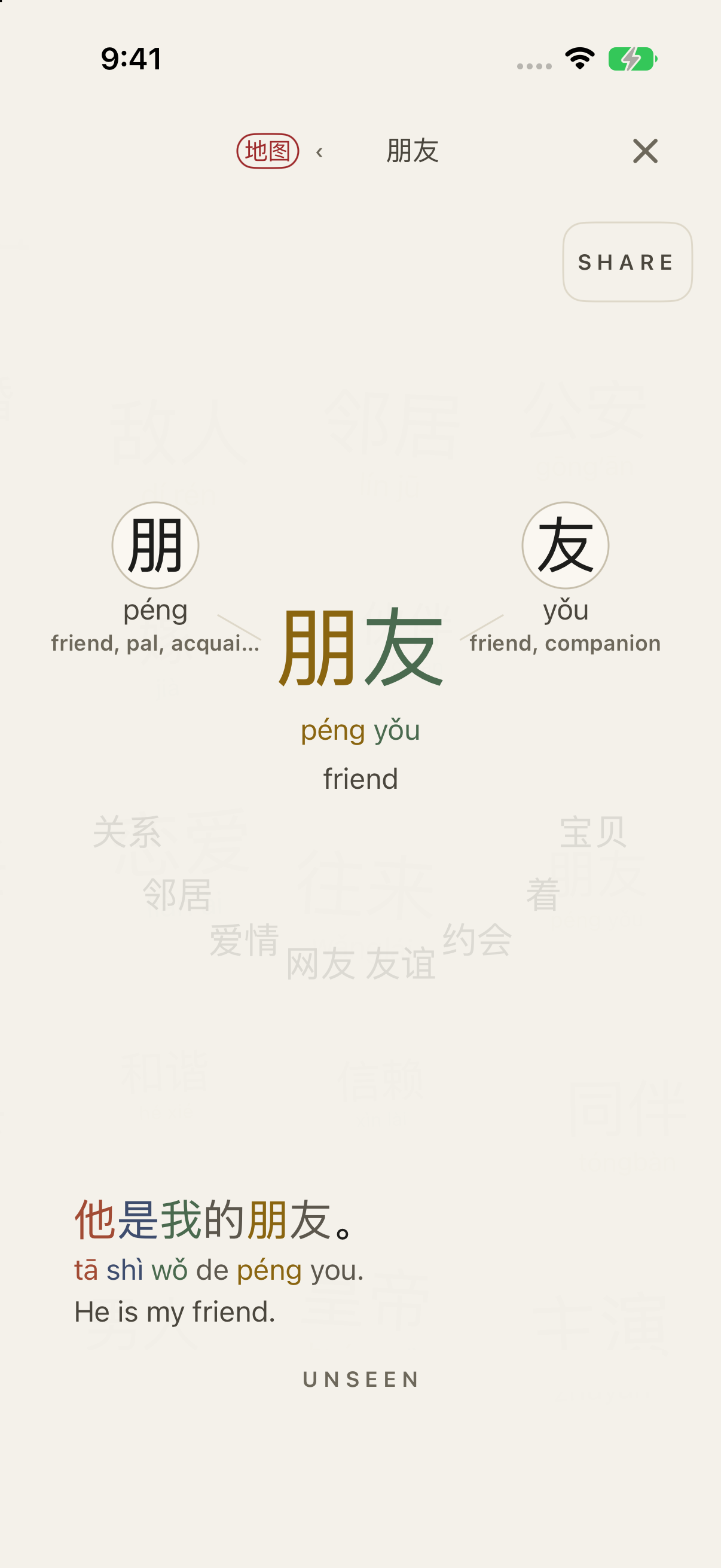
Every word opens like this in Lock In
Characters, readings and a real sentence, on your lock screen.

Word data: CC-CEDICT, CC BY-SA 4.0, adapted.